


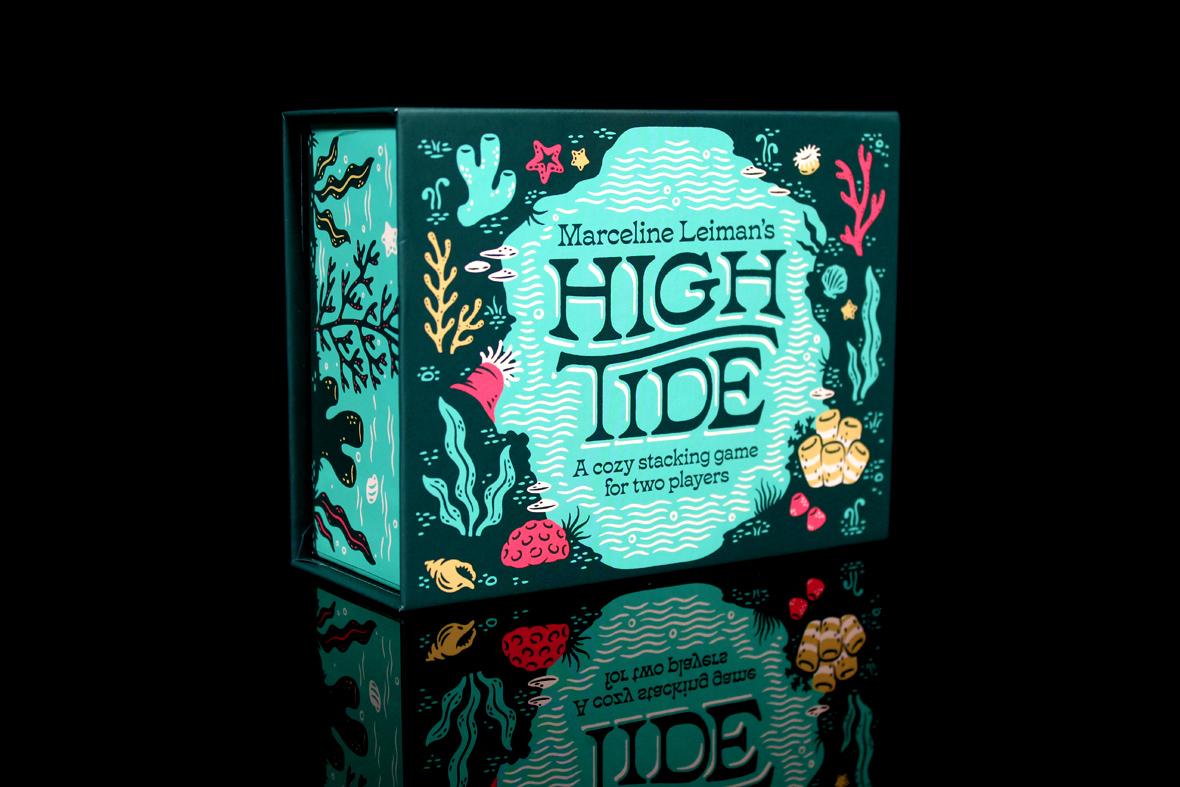
Base price: $25.2 players.Play time: 5 - 15 minutes.BGG LinkBuy on Amazon (via What’s Eric Playing?)Logged plays: 5
Full disclosure: A review copy of High Tide was provided by Roly Poly Games / Underdog Games.
I’m actually writing this at a decent hour, even though I’m a bit behind with my usual Gen Con prep. This one’s going to be out at Gen Con, I believe (barring things like shipping or production delays, as things happen in today’s economy). I do enjoy summery games releasing during the summer, and Gen Con is about as hot as it gets, unfortunately. Though hopefully it gets all of the rain out of its system by the time we show up. I’d be down for a thunderstorm, though; those are super fun. Water and precipitation aside, let’s check out High Tide!
In High Tide, players compete to place the highest tiles in the game. The challenge is that players can only move their tiles or neutral tiles and must always move them up. If you can’t move a tile, the round ends, and the player with more visible tiles (from the top) wins. You’ll have to be clever and plan ahead if you want to outfox your opponent. Will you be able to rise to the top?
Contents
- Setup
- Gameplay
- Player Count Differences
- Strategy
- Pros, Mehs, Cons
- Overall
Setup
Very little. Take the tiles:

Set them up so that there are three yellow, two blue, and two pink in the center, in this shape (configuration may vary; shuffle the tiles):

Shuffle the remaining tiles and build a ring around the central set. Set the score stones nearby:

You should be ready to start!

Gameplay

Pretty simple! Play best of five rounds; first to three wins!
Each turn, you must move either one of your tiles or a neutral tile to an adjacent spot. You can only move a tile if at least two edges are free, and you must move the tile so that it ends up on a higher level than it started. Naturally, you can’t move a tile such that it would split the board or something.

Once you can’t move a tile anymore, the round ends. Take a look at the play area from above; the player with the most visible tiles on top wins the round. If it’s a tie, the player with the tallest stack wins. If you’re still tied, the last player to move a tile wins the round. Reshuffle the tiles, reset, and the player who lost the round goes first in the next one.
First player to win three rounds takes the game!
Player Count Differences
None! Two-player only game.
Strategy

- Figure out how to limit your opponent’s movement. One of the best way to do this is to move tiles such that a stack of yours is only accessible from one adjacent tile. If you pull this off, then your opponent can’t move that tile because they’d be breaking up the group (explicitly prohibited by the rules).
- Cover your opponent’s tiles with yours. It prevents them from moving the tiles and reduces the number of tiles they have visible. Generally a low-effort useful strategy.
- Going after the highest stack is an interesting move, but you have to keep it protected from your opponent. If they have tiles or neutral tiles next to the tall stack, they can either cover it or claim it, both of which make things hard for you if there’s a tie. My advice
- You can force your opponent to make bad moves if you get lucky. Try uncovering neutral tiles; this can force your opponent to have to take a turn if there are none of their tiles left that they can move, and you might be able to apply pressure on them to move the neutral tile to a less favorable location. Or it might force them to move one of their tiles, uncovering one of yours.
- I try to always leave myself an exit. This usually involves keeping one of my tiles adjacent to an opponent’s tile that can’t be moved so that, in a pinch, I can cover their tile and start working my way up.
Pros, Mehs, and Cons

Pros
- I think this is a near-perfect game for a beach house. It’s the ideal theme and weight for such a thing if you’re getting into the (terrible) business of being an AirBnB owner. But, if you had this, that’s at least one choice I don’t have a personal problem with! But it pairs well with other abstract beach games like Seaside, if you’re looking to build a personal collection.
- I like the muted pastel art style! It’s classy and makes me think in some ways of the ocean. I kind of wish the yellow tiles had been more of a sand color, but, that’s just an aesthetics thing.
- It’s an exceedingly simple game to pick up and play. You just move a free tile up at least one level onto an adjacent tile. It’s great. There’s still pretty good strategy to it all, so it comes together nicely as a product.
- Portable, too; you don’t even really need the box. You can kind of just work with the bag at a certain point.
- The verticality of the game is a nice touch. I like it when games have some kind of 3D effect to them; it gives them some character and is a good way to improve table presence and overall appeal.
- The tiles are also a great size and weight. Big, chunky tiles do a good job improving appeal across age ranges, for instance; it’s a nice thing but also just satisfying during play.
Mehs
- One of my beads ended up being weirdly sharp. It’s kind of funny, so, hence the Meh, but one of them got mis-made and ended up being a little pointy? It has character, but it also makes me wonder how the beads get made. I’ll look into it on my time.
Cons
- I think the game performs just fine without the “best of five” thing that tends to happen with this stuff. Tracking sets of five to see who “won” rather than just having each round have a winner can be laborious for short games. I always say that it feels like there’s a lack of confidence in the design when that’s done. Most players, if the game is short and they have time, will just pick up a game and play again if they had fun and feel the need to settle the score. That’ll naturally hit a stopping point at some juncture; the game doesn’t need to be prescriptive about it. That said, this is a very common occurrence, so maybe I’m just wrong.
Overall: 7.5 / 10

Overall, I like High Tide. It’s a pleasant game that’s not asking for much but still provides a nice experience to all players, making it fit in perfectly with games like A Nice Cuppa or A Gentle Rain. There’s something to be said for this, and that’s probably that the rise in cozy video games and cozy board games are very much related. This enjoys the advantage of having a more aggressive sibling with a higher player count (Seaside, if you want to go that route), but on its own it’s great for a quiet night in or just a quick game to settle your brain or engage with another person. I stand by my earlier claim that this is also a good beach house game, but that’s such a specific genre that it’s hard to fight too hard for that. I think its low complexity holds it back a bit for me when it comes to my rating; not because it’s bad, but there are other vertical-focused abstract games that play quickly that I tend to prefer already (Santorini). There’s room in this world for many different kinds of games, however, and I like how quick this is to teach and play. Would happily do so again. If you’re looking for a quick and cozy two-player game, you prioritize portability, or you just want to spend a day at the beach (in your mind or otherwise), you might enjoy High Tide! It’s pleasant.
If you enjoyed this review and would like to support What’s Eric Playing? in the future, please check out my Patreon. Thanks for reading!
